NEWS
Join the ETHICAI project.
ETHICAI invites educators, institutions, policymakers, and researchers to follow the project and participate in its activities.
Through events, workshops, and the Community of Practice, ETHICAI aims to support a shared European approach to the ethical use of AI in higher education.
Stay connected to discover tools, research, and practical insights for the future of AI-enabled learning.
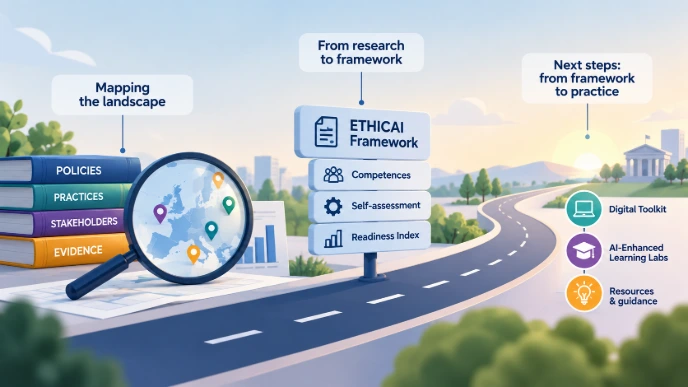
Image modified with ChatGPT (OpenAI)
The ETHICAI project is progressing from research and analysis towards the development of practical resources to support responsible Generative AI (GenAI) use in higher education.
Building on its initial findings, the consortium is developing the ETHICAI Framework to help institutions address AI competences, ethical considerations and readiness for GenAI integration.
This work will inform the ETHICAI Digital Toolkit, which is expected to include self-assessment tools, guidance and educational resources. An AI-powered assistant is also planned for a later stage.
Preparations are also underway for the AI-Enhanced Learning Labs, where project approaches will be explored in educational settings.
Through these activities, ETHICAI aims to equip higher education institutions, educators and students with practical support for integrating GenAI responsibly and effectively into teaching and learning.Università UNINETTUNO is developing an institutional AI Literacy Programme to strengthen the knowledge and competences needed for responsible Generative AI (GenAI) use in higher education.
Currently undergoing internal review, the programme combines a shared competence framework with tailored learning pathways, practical resources and activities to assess participants' understanding.
The initiative explores how AI literacy can be addressed across different groups within a university, taking into account their specific needs and responsibilities.
Insights from this work may contribute to ETHICAI's broader activities on AI competences and professional development, helping inform approaches that other higher education institutions could adapt to their own contexts.
By connecting competence development with practical learning opportunities, the initiative highlights the importance of supporting students and staff in navigating GenAI critically, confidently and responsibly.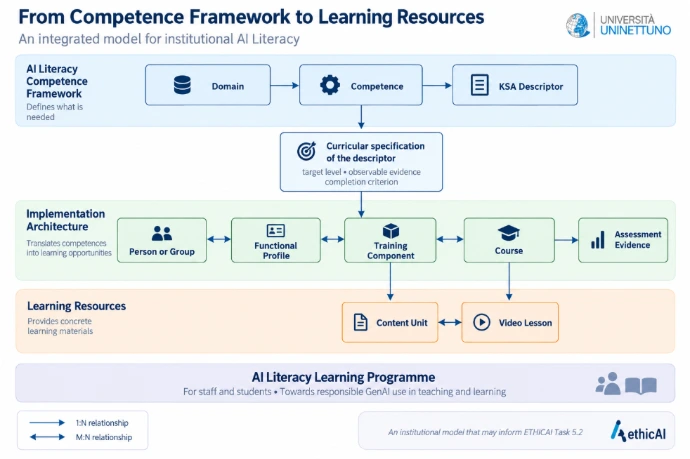
ETHICAI contributed to discussions on responsible Artificial Intelligence in education at ECTEL 2026 in Valencia.
During a workshop, Bhoomika Agarwal (OUNL) and Alessandra Antonaci (EADTU) engaged participants in exploring how AI can support education while preserving human judgement, autonomy and critical thinking.
The discussions addressed four interconnected dimensions: pedagogy, ethics, institutional implementation and policy. Participants reflected on issues including transparency, consent, privacy, accountability and the role of educators in AI-supported learning.
A central message was that integrating AI into education requires more than adopting new technologies. Institutions must also consider educational objectives, ethical responsibilities and the competences students need to develop.
The workshop provided valuable perspectives for ETHICAI's ongoing work towards ethical, responsible and human-centred GenAI integration in European higher education.
The European Commission and the OECD have recently launched the AI Literacy Framework (AILit), a shared reference for teaching AI in primary and secondary education. The framework describes what young learners should know and be able to do across four key areas: engaging with AI, creating with AI, managing AI, and shaping AI.
For the ETHICAI project, this is an important milestone. While AILit provides a strong foundation for school education, the need for AI literacy does not end when students enter university. Higher education brings new opportunities and challenges, as students, educators and institutions increasingly use generative AI in teaching, learning and assessment.
ETHICAI builds on this foundation by developing a comprehensive competence framework, self-assessment tools, a digital toolkit, and micro-credentials that help higher education institutions adopt Generative AI in ways that are ethical, inclusive and pedagogically meaningful. In this way, ETHICAI contributes to a continuous European approach to AI literacy—from school to university and lifelong learning
Read more about AILit here.


The EU AI Act is progressively becoming applicable across Europe. The Act entered into force on 1 August 2024, with AI literacy obligations and prohibited AI practices applying since February 2025. The next major milestone is 2 August 2026, when most of the Act’s provisions will start to apply, while certain high-risk AI rules will follow later.
For higher education institutions, this timeline reinforces the importance of responsible AI governance. As Generative AI becomes part of teaching, learning and assessment, universities are increasingly expected to address issues such as AI literacy, transparency, human oversight and ethical use.
This is where ETHICAI comes in. The project supports higher education institutions in translating these principles into everyday educational practice through its competence framework, Learning Labs, digital toolkit, CPD resources and AI literacy materials. Rather than focusing solely on compliance, ETHICAI aims to help universities integrate Generative AI in ways that are ethical, inclusive and pedagogically sound.
Read more about the EU AI Act here.

On 20 May 2026, ETHICAI was presented in Patras, Greece, during the 14th Regional Growth Conference, as part of the GenAISA workshop “From Artificial Intelligence to the Skills of the Future”.
Read more about the workshop here!
ETHICAI at Learning More Festival 2026
Right from the start, ETHICAI was introduced to the educational innovation community during the Learning More Festival 2026, held in Modena, Italy, from 20–22 February and organised by Future Education Modena.
The festival brought together educators, researchers, policymakers, and innovators to explore emerging trends and challenges in education. During the event, the ETHICAI team presented the project's aims, objectives, and planned activities, highlighting its commitment to supporting the ethical and responsible integration of artificial intelligence in education.
Participation in the festival provided an excellent opportunity to engage with a broad audience interested in the future of learning and to raise awareness of the project's vision and expected impact.
Find out more about the festival here!


The consortium met in person on 27 May 2026 in Athens, Greece, creating an opportunity to further align on the project’s work plan, strengthen collaboration, and discuss the next steps for the development of frameworks, tools, Learning Labs, microcredentials, and policy-related activities.
Together with the online project launch, these meetings set the foundation for a 36-month collaboration involving 13 partners from 9 countries, combining expertise in higher education, research, digital innovation, quality assurance, and policy.
ETHICAI Online Project Launch
On 27 March 2026, we launched ETHICAI – Advancing a Comprehensive Framework and Toolkit to Support the Ethical Use of Generative AI in Higher Education 🎓🤖
As generative AI continues to transform teaching, learning, and assessment, ETHICAI brings together a strong European consortium to ensure its use is ethical, inclusive, and pedagogically sound.
Over the next 36 months, ETHICAI will:
✨ Develop a comprehensive framework for ethical GenAI integration
✨ Design practical tools and an AI-powered digital toolkit
✨ Pilot AI-enhanced teaching through Learning Labs across universities
✨ Deliver microcredentials and capacity-building for staff and students
✨ Support policy development aligned with EU priorities
The project brings together 13 partners from 9 countries, combining expertise from higher education, research, innovation, and policy to drive real impact at scale

